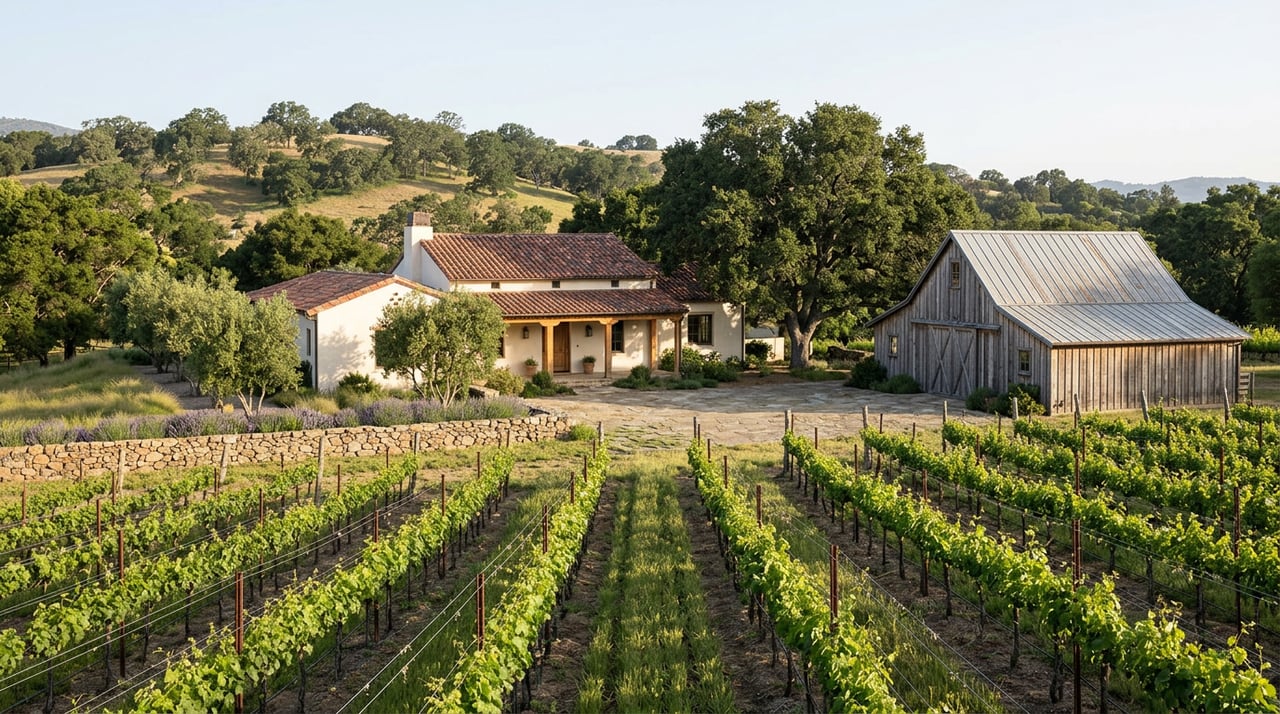
Drive out past the flagpole on Bell Street and the parcels get bigger fast. AG-II zoning, rolling grazing land, a working vineyard block, sometimes two wells on one listing sheet, one of them described as a large agricultural well cased and capped with an estimated output somewhere between 500 and 800 gallons per minute. It reads like a specification, the kind of detail a buyer skims past on the way to the photos of the tasting room and the oak canopy. In Los Alamos, that line is doing more work than it looks like it's doing.
Every one of those wells sits inside the San Antonio Creek Valley Groundwater Basin, a rural agricultural basin that the U.S. Geological Survey has flagged as heavily dependent on groundwater, with irrigated agriculture pushing demand hard enough over the decades to draw state oversight. Since 2017, that oversight has had a name, a board, and a meeting calendar. If you are closing on ranch or vineyard acreage here, that agency's paperwork is part of what you are buying, whether the listing mentions it or not.
The agency that never makes it into the listing description
The San Antonio Basin Groundwater Sustainability Agency, known locally as SABGSA, was formed in 2017 as a joint powers authority to implement California's Sustainable Groundwater Management Act across the basin. Its founding partner agencies have shifted over time. The Cachuma Resource Conservation District held one of the two founding seats until the San Antonio Basin Water District was formed in 2020 and stepped into that role. The other founding partner, the Los Alamos Community Services District, has been there from the start and still supplies potable water to the town's residential and commercial customers.
Both agencies meet at the same address, the Los Alamos Community Services District office on North St. Joseph Street. The water district board meets there at 1 p.m. and the groundwater sustainability agency board meets there at 6 p.m., both on the third Tuesday of every month. It is a small enough operation that two separate public agencies share a single meeting room on the same day. That is not a knock on the town. It is a signal of how tightly the water governance here is wound around a handful of local offices, which means the paperwork trail is short and traceable if you know to look for it, and easy to miss if you don't.
Two deadlines that already passed this year
Here is where it gets specific to 2026. The water district's compliance materials list a Flow Meter Installation and Calibration Compliance Form that came due April 1, 2026. Separately, the agency's Well Meter Assistance Program, which reimbursed landowners up to $500 for purchasing and installing an eligible flow meter, ran until June 30, 2026 or until its funding ran out, whichever came first.
Both of those dates are behind us now. If you are looking at a ranch or vineyard parcel in Los Alamos today, the well on it should already have a calibrated, compliant flow meter installed, and the seller should already have filed that compliance form months ago. That is a very different question to ask in escrow than "does the property have a well." It is closer to "has this well already cleared a 2026 regulatory deadline, or is it sitting on a compliance gap that transfers to me at closing." A missing meter or an unfiled form is not automatically a dealbreaker, but it is exactly the kind of thing that is invisible on a walkthrough and expensive to discover after you own it.
Who actually pays for this
The San Antonio Basin Water District funds SABGSA's operations and its Groundwater Sustainability Plan through a Proposition 218 assessment levied on irrigated and non-irrigated agricultural parcels within the basin. Aside from occasional grants and in-kind support from the Los Alamos Community Services District, that agricultural assessment is currently the only funding source keeping the groundwater sustainability program running.
That matters for anyone buying land zoned for vineyard, row crop, orchard, or cattle use in this basin, because the assessment is attached to the land's agricultural designation, not to the house sitting on it. A buyer comparing two otherwise similar parcels, one classified as irrigated agriculture and one carrying a residential-only designation, is not comparing apples to apples on ongoing carrying costs. That distinction rarely shows up in a listing price per acre.
| What the listing tells you | What it doesn't tell you |
|---|---|
| Well is cased, capped, rated at 500 to 800 GPM | Whether the well has a compliant flow meter as of the April 2026 deadline |
| Parcel is zoned AG-II | Whether the parcel carries a Prop 218 agricultural water assessment |
| Property has private well water | Whether the well falls under active SGMA basin management, not just county well permitting |
Why the board seats matter if you're buying a vineyard
The GSA's board is not a generic bureaucratic body. Its seven water-district-appointed seats are allocated by land use category: two directors represent vineyards, two represent row crops, one represents orchards or other permanent crops, one represents cattle operations, and one represents transitional land suitable for but not currently used in agriculture. An eighth director is appointed separately by the Los Alamos Community Services District.
If you are buying vineyard acreage in this basin, two of the eight votes on the agency that governs your future pumping allocations are structurally reserved for vineyard interests. That is a meaningfully different governance picture than a generic county water district where agricultural users have no dedicated voice. It means the plan being built around your parcel's water use has vintners at the table by design, which is worth knowing whether you find it reassuring or want to ask harder questions about how those allocations get decided as the basin's Groundwater Sustainability Plan matures.
What to actually ask before you remove contingencies
A well inspection and a flow test tell you whether the pump works today. They do not tell you whether the well is compliant with basin governance that has real deadlines attached. Before contingencies come off on Los Alamos acreage, it is worth getting written answers to:
- Has the well's flow meter been installed and calibrated, and was the compliance form for it filed with the water district on schedule
- Is the parcel currently assessed under the Prop 218 agricultural water charge, and if so, what has that assessment run in recent years
- Does the seller have any correspondence from SABGSA or the San Antonio Basin Water District regarding this specific parcel
- If the property includes more than one well, are all of them accounted for in the district's records, not just the one mentioned in the listing
None of these questions require a hydrologist. They require a phone call to the water district and a seller willing to produce paperwork that most buyers never think to request.
A few questions worth asking directly
Does every well in Los Alamos fall under this basin's rules? Any well drawing from the San Antonio Creek Valley Groundwater Basin falls under the Sustainable Groundwater Management Act as implemented locally by SABGSA. Wells outside the basin boundary follow standard county well permitting instead, so confirming which side of that line a specific parcel sits on is a reasonable first question for a title or water district records check.
Is the agricultural assessment something I can just decline to pay? The Prop 218 assessment is levied on the parcel's agricultural designation, not on the current owner personally, so a change in ownership does not remove it. If the land carries an irrigated or non-irrigated agriculture classification, the assessment is part of the cost of holding that classification going forward.
Buying land in wine country here means buying into a water governance structure that has been quietly building compliance deadlines for years and hit two of them already in 2026. That is not a reason to walk away from a good parcel. It is a reason to ask sharper questions before the contingency period runs out.
If you are looking at ranch, vineyard, or ag-zoned acreage anywhere in the Santa Ynez Valley and want someone who tracks this kind of detail before it becomes an escrow surprise, Wade Koch has spent his career treating disciplined preparation as the whole point of the job. Let's Connect — Schedule a Free Consultation.